

How to Run with Asthma: TL;DR
- Roughly 15% of athletes are diagnosed with exercise induced asthma (EIA), but many people believe it’s a make-believe condition.
- You can still be a runner if you have exercise-induced asthma, traditional asthma, or even exercise-induced bronchospasms.
- If you feel short of breath, tightness in your chest, wheezing, and taste metal in your mouth…go to a doctor ASAP.
- Learning how to run with asthma means that you have to alter how you train, not that you can’t train.
- Don’t compare yourself to athletes who don’t have asthma. Your performance and experience will differ from theirs.
- You will likely progress more slowly than other people and plans say you should, but you will progress.
- If you’re looking for EIA treatment, go see a doctor (please). What my doc said to do, and what works for me, is to use an Albuterol inhaler about 15 minutes before I run.
- Listen to your body. If it says you need to slow down or shift some training days or distances, do it.
I Run with Asthma
Hi. I’m Beej, I’m a runner, and I have asthma. I know from experience how tough this road can be. And that’s not even including the shock from the pavement. (That’s a road running joke, har har.)
I started out at 310 pounds and unable to run, and eventually lost down to 155 and doing half-marathons. And there are a few things I learned along the way that helped me get miles on my shoes and air in my lungs. Through it all, I dealt with asthma
1. Remember, Running is Hard
Starting to run is even harder. And, if you ask me, running with asthma (and starting to run with asthma) is a step above both. It’s very hard.
In general, when you start to run, if you put in the time and effort, you’ll be wearing out the soles of your running shoes in no time. Just turn on something like Zombies 5k, and you’re just 8-9 short weeks away from being race-ready (and potentially willing).
Unless you have asthma.
Now, don’t get me wrong. You might be able to run a 5k in 8-9 weeks (from nothing) if you deal with asthma. It depends on the severity of your condition, and a number of other factors. But most likely, it will take you longer than any training program’s advertised length.
Why? Because running with asthma means that what might be a difficult task for most people can become exponentially worse for you. It’s
2. Running with Asthma Is Not Impossible
Lucky for you and me, though, having asthma doesn’t mean you can’t be a runner. It doesn’t mean you can get fit, that you can’t lose weight. All running with asthma means is that you have to account for your asthma when you’re running.
That’s it.
I’m living proof of that. I have a pretty severe case of exercise-induced asthma, and as I trained and learned about taking care of myself, I eventually got up to 120ish miles per week.
So far I’ve run three half-marathons, umpteen 10ks and 5ks, and thousands of training miles.
3. Exercise-induced Asthma is Real
For some reason, people like to think that exercise-induced asthma doesn’t exist. Despite being diagnosed in roughly 15% of athletes, I’ve gotten a lot of flak from folks when I tell them I have exercise-induced asthma.
For example, when I first started running, people would see a 310-lb man who runs for 15-30 seconds and then has to take a 5-minute break to catch his breath. Maybe I even had to stop and take a sit-down. In their eyes, they saw a fat guy trying to exercise and failing.
“Durr, durr, you’re a fat guy and can’t run because of asthma. Right. Sure. Durr, durr.”
That’s not the case, though. Exercise-induced asthma affects way more than just obese folks. A lot of that push-back comes from ignorance, so you can’t blame them. They don’t know any better.
Don’t let people shame you into not taking your health seriously. Running while overweight can be tough, and running with asthma (especially while obese) is not just harder — it can be dangerous.
I understand being self-conscious about it (I was and still kind of am). But don’t let anyone mock you so that you don’t take the way you feel seriously.
If your chest feels tight and wheezy when you exert yourself, you get a metallic taste in your mouth, and you can’t quite catch your breath when you exercise, then see a doctor. Please.
A talk with my doctor really opened my eyes about how to approach running with asthma. At some point, I had been prescribed an albuterol inhaler and told only to use it when I had an attack. However, when I switched to a new doc, she told me that it was okay to take a dose before I ran (two puffs), and that she had a swimmer friend who did that. It had made all the difference for her.
So I tried it, and it worked for me, too! It was awesome. That first day, I ran longer and could breathe better than I ever had before.
So go see a doctor. If they determine that you do, indeed, have asthma, then you just have to train your body and strengthen your lungs. Just make sure to keep your inhaler nearby. This is very important. Even though I use it before I I keep my albuterol inhaler nearby when working out, even when I haven’t had an attack in months.
4. You ARE Different. Train Like It.
One problem for me, though, was that I still couldn’t quite hit the intervals I wanted to. Even pre-gaming with my inhaler, running with asthma was making things harder. I came closer to my goal, but I still couldn’t progress as fast as some of the training programs wanted me to.
And again, after a while, I realized that was okay. If you have asthma, you aren’t the program’s target audience. You’re different. You have a medical condition.
In general, a good rule of thumb is doubling the length of an interval training program to account for asthma. If a program or app says it can get you into running a 5k in 9 weeks, then you’re probably safe to assume that it would take someone with asthma 18-20.
Don’t feel bad about that, either. You’ll get there.
It might take you longer to hit certain milestones than someone without asthma, but you’re overcoming a lot more than just leg aches, shin splints, and scheduling conflicts to get to the gym, you know?
If you look at it like that…you’re kind of a badass, right?
5. Stop Comparing Yourself to Others
My wife and I started running at about the same time. At the time, she was in way better shape than I was. I wasn’t in terrible shape, having already lost 100 pounds, but I was not “fit” by any means.
When we started to run, we both kept approximately the same running schedule. And by the time she was running a solid two miles, I was just breaking into my first nonstop mile.
I was pretty bummed out about it. Here I was, in the best shape of my life (at the time), and my wife was progressing twice as fast as I was. It was disheartening. I probably (read: definitely) got kind of pissy about it.
Until I finally wrapped my head around that she wasn’t running with asthma. Sure, she was running twice as much as I was, but how did that affect me?
Answer: It didn’t. It didn’t affect me at all.
So I stopped comparing myself to her and started listening to my own body. I would alter my pace based on how tight my chest felt. Some days, my intervals were 5 minutes long. Other days, they were 10. Sometimes, I had to walk a full 6 minutes before being able to jog for 2.
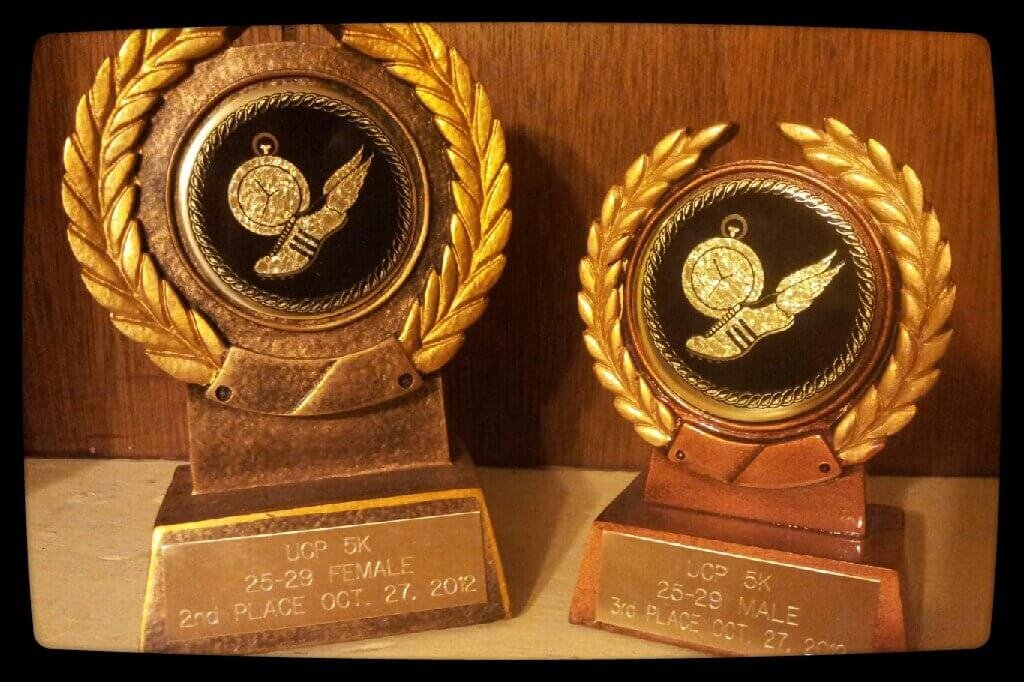
But in the end, when I stopped thinking of myself as inferior, I was able to push through and reach my goals. At our first race together, I ran a 27 minute 5k, while my wife did it in 31 minutes.
I won! (But her trophy is bigger, so it evens out.)
You Can Do This!
It is definitely possible to run with asthma. It’s not just a fallback excuse so fat people can get out of exercise. It’s a legitimate health condition. Having asthma is no reason not to run or to exercise in general. Sure, there’s something to deal with, but it’s not an immovable wall.
If you know how to train for it and take the right precautions, there’s no reason why you can’t become a runner if you have asthma.
You might train slower than some folks. You might have to slow down and do run-walk-run intervals instead of solidly running for miles upon miles. And you might have to keep your handy-dandy inhaler with you wherever you go.
Running with asthma–and learning to live with it–has been one of the greatest accomplishments of my life. Dealing with it has made me stronger and more capable. I am in the best shape of my life, and I am doing something that I love despite having a major medical issue that many people think is inhibiting.
Asthma really isn’t. You just…kind of have to outrun it a bit.
What have your experiences been with asthma and running? Let me know in the comments or hit me up on Twitter!
Thank you for the much needed inspiration! I have asthma and I am just starting to run, and I find it very discouraging. I googled running with asthma apps and there are none.
Did you use an app or a program when you started out?
I personally am not aware of any app for this. Think of your lungs as a muscle group like any other that needs to be strengthened through exercise, but especially through high intensity workouts. I began with run walk intervals—because well, you’ll pass out if you don’t 😁
If it means 20 or 30 seconds at a time of running, then 3-5 minutes of walking for 20-30 minutes for a week, two, or a month—do what it takes. Running is worth it and you can do it. It does get better, I’ve been there, too.